Data City, como as startups e os grandes grupos, podem cooperar no serviço da Smart City?
Com o apoio de grandes contas, cinco startups testaram a sua inovação baseando-se na análise de dados urbanos, em diversos domínios capitais para a Smart city de amanhã, graças à análise dos dados urbanos, no quadro de um concurso organizado pela Numa e pela Cidade de Paris.
Por: Mounia Van de Casteele Fonte: La Tribune
Les cinq duos (Openenergy et Nexity, Padam et Vinci, Sensewaves et Setec, Qucit et Cisco, Egreen et Suez) présentaient mardi au Champ de Mars, le résultat théorique de leur expérimentation. (Crédits Datacity - PitchDay (95)
Avec le soutien de grands comptes, cinq startups ont testé leurs innovations en se basant sur l'analyse de données urbaines, dans divers domaines capitaux pour la Smart city de demain (mobilité, transition énergétique...) grâce à l'analyse de données urbaines, dans le cadre d'un concours organisé par Numa et la Ville de Paris. Leurs résultats, impressionnants, leur ont donné envie de passer très rapidement de la théorie à la pratique.
Comment utiliser le Big data pour améliorer le quotidien des habitants ? Tel était le défi proposé par Data City, un concours organisé par l'accélérateur de startups Numa en partenariat avec la Ville de Paris, et dont les résultats étaient présentés mardi soir au Champ de Mars.
Cinq jeunes pousses triées sur le volet, dans différents domaines comme la mobilité ou encore la transition énergétique, ont ainsi testé leur innovation, grâce à l'analyse de données urbaines, sur un terrain de jeu grandeur nature de la capitale, avec, chacune, le soutien d'un grand compte, afin de répondre à des problématiques cruciales pour la ville intelligente de demain. Les cinq duos (Openenergy et Nexity, Padam et Vinci, Sensewaves et Setec, Qucit et Cisco, Egreen et Suez) ont tous fait part de leur (heureuse) surprise quant au potentiel d'une telle collaboration en présentant les résultats théoriques de leurs expérimentations empiriques. Améliorer le bien-être des passants
Par exemple, la startup Qucit a planché sur sur l'amélioration des espaces publics afin de les rendre plus agréables pour les usagers, avec pour terrain d'expérimentation la place de la Nation. L'une des sept places que la mairie de Paris souhaite réaménager dans le but de favoriser les espaces dédiés aux cyclistes et aux piétons.
Résultat: en étudiant le ressenti de quelque 1.300 passants interrogées, la startup a notamment identifié au mètre près les zones de stress et celles où les piétons se sentent le plus en sécurité. Et a ainsi pu dresser une cartographie extrêmement précise de la place. Les espaces jugés les plus anxiogènes étaient précisément deux passages pour piétons, et ceux où ils se sentent le mieux : le terre-plein central, qui s'avère aujourd'hui assez difficile d'accès pour les piétons. De quoi aider la Mairie de Paris à opérer les aménagements adéquats pour le bien-être de la collectivité. Mutualiser les énergies entre bâtiments voisins
De la même manière, le duo Nexity Openenergy s'est penché sur la question énergétique. Leur postulat de départ : on ne partage pas l'énergie aujourd'hui, alors que les milliers de kilomètres carrés de bureaux urbains sont utilisés la journée seulement, au moment où les habitations sont vides, et inversement. Le défi consistait donc à tester une éventuelle mutualisation de l'énergie à l'échelle d'un îlot. Avec pour terrain d'expérimentation trois sites parisiens : une crèche, un bâtiment de logements et un immeuble de bureaux.
Après simulation, le duo est arrivé à la conclusion suivante : la récupération d'énergie dans les bureaux étudiés permettrait d'alimenter en énergie une crèche ainsi que 16 bâtiments de logements ! Des résultats plus que prometteurs donc, en matière de rénovation de logements existants et de construction de bâtiments neufs. Une collaboration fructueuse
Bref. Cette collaboration jeunes pousses - grands comptes a permis d'obtenir des résultats concrets, et surtout impressionnants. Avec l'objectif pour tous les lauréats de sauter le pas, et de passer de la théorie à la pratique désormais, comme nous l'explique Ziad Khoury, co-fondateur de la jeune pousse Padam, l'une des lauréates de Data City, spécialisée dans le transport collectif urbain à la demande (notamment les trajets domicile-travail) et qui avait pour partenaire le groupe Vinci :
"Habituellement ce sont les grandes entreprises qui veulent travailler avec les startups mais sans avoir le même process, souvent inadapté pour une startup, avec une approche différente, aussi bien culturellement qu'au niveau de la temporalité".
"A titre d'illustration, si j'envoie un mail, il n'est pas rare que l'on me réponde au bout de trois semaines pour prendre un rendez-vous dans deux mois... Alors que tout va très vite aujourd'hui, et plus que jamais pour une startup "time is money"!
Aussi a-t-il apprécié le concours, qui, selon lui, était tout-à-fait en adéquation avec les contraintes d'une startup:
"L'aspect positif de Datacity était la dynamique de l'initiative d'une part, et d'autre part sa flexibilité et sa souplesse, qui a permis d'adapter la méthodologie et la réflexion en fonction des différents retours d'expérience de chacun. L'approche était très startup friendly, en phase avec le fonctionnement d'une jeune pousse".
Surfant sur la vague du succès rencontré par le projet, Anne Hidalgo, la Maire de Paris va le porter au C40. Et Data City va ainsi s'étendre à d'autres villes françaises, mais également à l'international (Casablanca et Mexico). "De quoi montrer l'exemplarité de la capitale de l'Hexagone en matière de Smart City", se réjouissent Marie-Vorgan Le Barzic, Présidente de Numa et Jean-Louis Missika, adjoint à la Mairie de Paris chargé de l'urbanisme. Avant de confier, un large sourire aux lèvres :
"Pour l'édition parisienne de 2017, de grands groupes ont d'ores et déjà manifesté leur intérêt. A l'instar de la RATP Dev qui a répondu présente. Avis aux amateurs !"
O projeto europeu tal como está agora não é baseado no amplo consenso da opinião pública europeia, e é por isso que os populistas e a propaganda russa são tão bem sucedidos, escreve Tomáš Zdechovský. Por: Tomáš Zdechovský Fonte: EurActiv
Without citizens’ support, EU falls pray to populists and Russian influence
The European project as it stands now is not based on the broad consensus of the European public, and that’s why populists and Russian propaganda are so successful, writes Tomáš Zdechovský .
Tomáš Zdechovský is Member of the European Parliament (Czech Republic, EPP).
The European Union is currently facing many important challenges – which include not only external attacks and problems, but also criticism from within the European Union, from the citizens themselves. It needs to deal with disputes between the member states, while its very existence is jeopardised by the possibility of losing some of the member states.
What I see in the history of the European project is that the very existence of the European Union is defined by a constant struggle. A struggle against external enemies or internal circumstances, but nevertheless a struggle. We can look at it in two ways: either as an impossible challenge or – and this is a view that we all here share and it is also the reason why we are here today – we can view it as a mission. Because the EU was created to face challenges, fight enemies and mitigate crisis.
And the more challenges we face, the more raison d’être is given to the European Union. I would like to highlight several concrete issues, which I think are the most pressing ones and which pose the largest challenge but which – in my view – are only a confirmation for the necessity of the united Europe.
Maybe paradoxically, the biggest challenge is the loss of trust in the European project and the open resistance of European citizens against the European Union. The results of the European elections in 2014 have shown that the disillusion affects all EU countries. If we want the European Union to remain strong and keep its touch of glory, we cannot ignore or trivialise this problem.
We need to understand the depth of the resistance against the European project and instead of imposing rules and expressing threats, we must offer an alternative solution that will bring Europeans back together. This is the only way that the EU will become attractive and legitimate once again. The basis of the EU lies on democratic values and such a structure will not be able to function without a full support of its citizens.
A research conducted after the elections (in early 2015) revealed that only 51% of European citizens considered EU membership to be a positive thing. This means that the European project is not based on overall consensus of the European public. We need to understand that half of the European citizens are indifferent or negative towards the membership in the EU. Many voiced concerns across the continent call for restriction of the European integration – and I can illustrate this on the example of the United Kingdom or even my homeland the Czech Republic, two countries who are massively critical of the European Union.
Now – what solution is there? European politicians necessarily need to come closer to the citizens. Indeed, this is a phrase that we hear far too often but what does it really mean? From my own experience, the solution is communication: giving information, explaining, debating, respecting opposing opinions, giving insights – this all can be done via media and through personal contact. Helping people with their concerns and decreasing their fears is a way to go. We must not be deaf to the problems of the ordinary citizens.
Quite the contrary, we politicians need to take the responsibility for presenting the benefits of the EU membership to the public. I wish that the European citizens are able to identify themselves with the EU project and this will be possible only with politicians capable of understanding the deepest concerns within the society. And that will also lead towards legitimisation of further and much deeper integration because we can influence people to identify with the EU.
Secondly, the European Union is facing threats from the outside. Even today, 25 years after the dissolution of the Soviet Union, we are subject to the political claims of the large and powerful actor on our eastern border. Russia still poses a threat to the peace on the old continent. The strengthening of the unity of the EU member states should be a priority of the European leaders, because unity is our most important defensive mechanism against the destructive Russian tactics. The EU and NATO must play their part in ensuring the EU security and safety of European citizens.
Russian propaganda is one the main threats to the European peace. Its inconspicuous character spreads within the European public and Europe has not been until now well prepared to deal with it. Russian propaganda is especially aimed at post-communist countries that were once under its sphere of influence. Their democracies are still fragile because they need to fight a higher rate of domestic dissatisfaction and a lower level of trust in democracy. Therefore, Russian propaganda is more successful with some of the newer member states.
The Russian political approach capitalises on current crises within the EU: the threat of Brexit, the migration crisis or the financial crisis and the economic situation in Greece. Russia spreads its influence through support of extremist political parties, especially in the right wing. It is now proven that, for instance, the French National Front accepted money from Russia. This is a cross-border issue that calls for a united action and that can be successfully addressed only if the member states deepen their cooperation mechanisms.
Finally, the third big issue is also an external factor, which has a massive impact on the EU policies. The migration crisis is one of the most influential phenomena shaping the current European political scene and that will have also an immense influence on the future of the EU.
Right-wing and extremist parties take advantage of the situation, thanks to the deficiencies of the migration policies so far. The chaos accompanying the refugee crisis is an evidence that more integrated European policies are needed in order to successfully address the very complex, transnational issues that are not solvable on national level.
What we need are clear, comprehensible and consistent policies that will be understandable also to the wide public. Therefore, we need an open, public debate about the issues that affect regular citizens. The absence of such a debate would be a tragedy for the future of Europe.
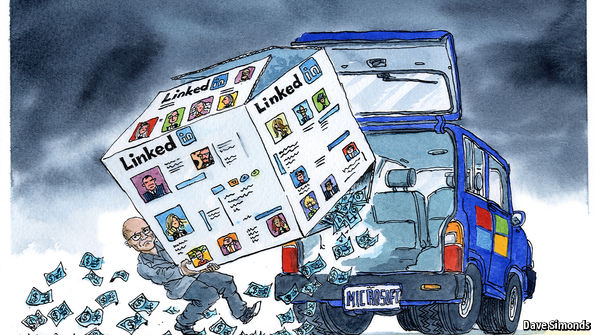
“IMAGINE a world where we’re no longer looking up to tech titans such as Apple, Google, Microsoft, Amazon and Facebook...because we are one of them.” So wrote Jeff Weiner, boss of LinkedIn, in an open letter on June 13th. Not much imagination is necessary. Microsoft had just announced it would pay $26.2 billion to buy the professional social network, making it the third-largest acquisition in the history of the tech industry. The deal was accompanied by substantial promises from Mr Weiner and Microsoft’s boss, Satya Nadella, that the deal would transform businesses’ and workers’ productivity worldwide. Those pledges seem fanciful.
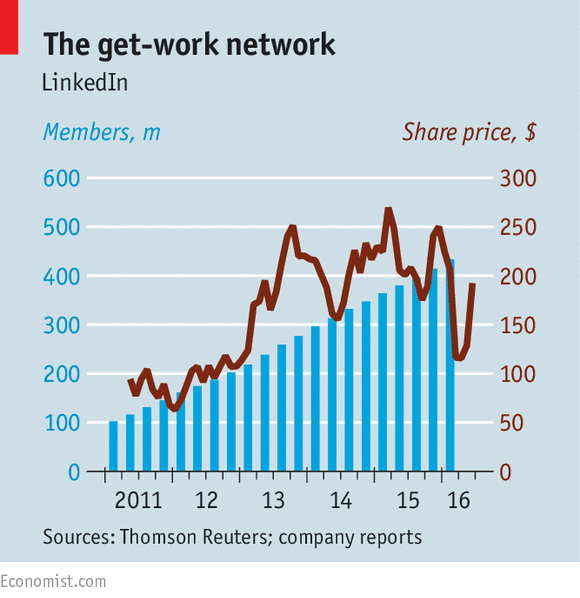
Microsoft is paying a high price for a firm that has suffered its fair share of setbacks. Although LinkedIn is the largest professional social network by far, with around 430m registered users and 100m visitors to its site each month, some analysts have questioned how much bigger it can become. LinkedIn makes most of its money by selling subscriptions to corporate recruiters, who prowl through its database of executives looking for prospective employees. Revenue growth has been slower than expected, and rolling out new businesses and improving existing ones has proved pricey.
Concerns over the pace of progress came to the fore in February, when LinkedIn’s share price sank by more than 40% in a day, shedding $11 billion from its market value, after the firm reported that forecasts of revenues for 2016 were lower than expected. LinkedIn had also revealed that it made a net loss of around $165m in 2015, despite revenues of $3 billion, in large part because of excessive stock-based compensation. The decline was the biggest one-day fall since the company went public in 2011. Its share price has not fully recovered.
Despite these worries, Microsoft paid a generous 50% premium over LinkedIn’s share price to acquire the firm. Michael Cusumano at MIT’s Sloan School of Management reckons that the social network would have cost considerably less in a year’s time. Mr Nadella may have felt that he could not wait.
Unassailable during the desktop-computing era, Microsoft is still the world’s largest software-maker, but now has to compete with rivals such as Google and Amazon as computing shifts towards mobile devices and the cloud. Unlike his predecessor, Steve Ballmer, who was slow to invest in these areas, Mr Nadella has a grand scheme to reposition Microsoft. This involves putting less emphasis on Windows, the firm’s flagship operating system, as well as beefing up cloud computing and putting the firm at the forefront of advances in machine learning and artificial intelligence.
Acquiring LinkedIn is an element of this masterplan. The social-network firm has an enviable team of data scientists, a commodity coveted by tech firms. These boffins design algorithms to find patterns in big piles of digital information. LinkedIn will be useful to Microsoft for other reasons, too. The firm gathers detailed information about its users, including their employment history, education and whom they know. These data could prove valuable to Microsoft as it attempts to build offerings for managing relationships with customers and to compete with Salesforce, a firm it reportedly tried to buy last year.
The two firms could not agree on a price at the time. Salesforce’s current market value is around $55 billion. LinkedIn is a cheaper substitute. It will also dovetail with Microsoft’s existing products in Office, its collection of business applications and services that includes Word, Excel and Outlook, an e-mail system. The latter might gain in popularity if LinkedIn keeps users’ details up to date and offers alerts if a contact moves firms. Such extra features should, in theory, encourage companies to buy new cloud services from Microsoft.
Even so, the deal’s rationale looks questionable. Mr Nadella has suggested that with LinkedIn, Microsoft will become the platform for managing workers’ personal details from around the web. He also promises that Microsoft will become better at predicting what information users might find useful, suggesting news articles related to a project someone is working on or recommending a friend of a friend online who might be able to help an employee with a task at work. In this vision, LinkedIn’s “newsfeed” will become a focus for information-sharing at the office.
Is it worth it, let me work it
There are three hitches in Microsoft’s plans. The first is financial. It is shelling out the equivalent of around $260 for each monthly active user of LinkedIn. To keep shareholders happy, it will need to add users to LinkedIn’s platform more quickly or be clearer about how it can make more money from their data.
The second is operational. Microsoft’s record with big deals is poor. Its purchase of Skype in 2011 for $8.5 billion has been no runaway success. Microsoft squandered over $6.3 billion on aQuantive, an online-advertising firm that it bought in 2007, and $7.6 billion on Nokia’s handset business in 2014. Both misfortunes happened before Mr Nadella took over, but “the historic playbook says it’s not going to work,” reckons Brent Thill, an analyst at UBS, a bank. Mr Nadella intends to keep LinkedIn as an independent company, perhaps because he has seen the pitfalls of integrating large acquisitions at first hand.
The third hitch is behavioural. Mr Nadella wants LinkedIn to become the place to go for news and other details about people’s work lives, but firms are unlikely to want to give their employees more of an excuse to spend time on social media. Some bosses regard LinkedIn with hostility because it makes money from recruiters out to poach their staff. They will not want to let LinkedIn further embed itself at their companies. Already some large firms block or restrict access to LinkedIn on their networks. Users may also grow uncomfortable if Microsoft deploys their data elsewhere and could stop using the service. Mr Nadella has acknowledged they will have to treat what they know about users “tastefully”.
The deal has been welcomed for other reasons, however. It could signal an impending tech buying spree. In the days after LinkedIn’s purchase, investors looked around to see which other firms Mr Nadella and his peers might have their eyes on. Optimists pushed up the share price of Twitter, another social-media firm whose growth prospects have been questioned, in the hope that a buyer might make a move. But not every tech firm is lucky enough to have Mr Nadella coveting it.
Que estratégia política deve a UE e os seus dois maiores membros, França e Alemanha, prosseguir se o Reino Unido sair?
Para evitar uma desintegração gradual da UE, os líderes políticos terão de reforçar a atratividade da UE e, especialmente, a aliança franco-alemã. O consenso entre os economistas é que sair da UE seria prejudicial tanto para o Reino Unido como para a UE, mas poderá acontecer. Preparar as próximas etapas é crucial.
O instinto entre os formuladores de políticas, tanto em França como na Alemanha é para trabalhar mais estreitamente juntos depois de um Brexit. ... Confrontada com o risco de uma desintegração gradual de toda a UE depois do Brexit, uma forte liderança política deve implementar uma estratégia política audaciosa.
Por: Guntram B: Wolff Fonte: Bruegel
Ver também:
O que pode ser um sistema de imigração do Reino Unido pós-Brexit?
O que é que as campanhas de permanência e saída dizem sobre a futura política de imigração? Sem surpresa, a campanha Permanecer tem sido relutante em discutir a imigração, dado que a maioria do público vê a livre circulação como um custo e não como um benefício. No entanto, durante o debate da noite passada na Sky News, o primeiro-ministro David Cameron disse que, na sua opinião, uma vez que a crise da zona euro diminui o fluxo de cidadãos da UE para o Reino Unido e o fluxo de nacionais do Reino Unido para o resto da UE estará "amplamente em equilíbrio ", e que as alterações aos benefícios dos migrantes da UE incidirão ainda sobre migrantes pouco qualificados, de baixa remuneração. Fonte: Bruegel
Com o Brexit Londres perderá negócios como centro financeiro global
Existem vários sub-cenários no rescaldo de um voto Não a 23 de junho. Em quase todos, no entanto, Londres perderia negócios como centro financeiro global. Parte da sua posição ímpar como um hub para serviços financeiros internacionais está ligada à sua adesão à União Europeia e o correspondente acesso ao mercado interno da UE. Por: Nicolas Véron Fonte: Bruegel
É chegada a hora de cumprir as promessas do Mercado Único Digital. Pode um mercado único digital dar à Europa a liderança? O objetivo do mercado único digital europeu parece difícil de alcançar. Fonte: Computer Weekly Mercado único numérico Mercado único numérico: fazer de forma que as liberdades que fundam o mercado único da UE se apliquem igualmente ao numérico Fonte: EU A Comissão dá um passo importante para um mercado único digital A Comissão pretende impulsionar o e-commerce, abordando o geoblocking e tornando a entrega de encomendas transfronteiras mais acessível. Fonte: EU O mercado único digital é adiado A estratégia do mercado único digital festeja o seu primeiro aniversário hoje. Por: Catherine Stupp Fonte: EurActiv Comissão Europeia revela as novas propostas para o mercado único digital As propostas da Comissão visam conduzir o e-commerce transfronteiriço na UE e nivelar o campo de regulamentos em todos os serviços de comunicação audiovisuais e plataformas online. Fonte: Lexology
It is high time to deliver on the promises of the Digital Single Market (DSM). It will fuel European economic growth, and a way to make the everyday life of businesses and consumers easier, writes Tomasz Poręba.
The European Commission’s Digital Single Market strategy turned one year old last week and so far, no single big step has been taken. We should bear in mind that the digital economy is today the single most important driver of innovation, competitiveness and growth. This year it is expected that almost half the world’s population – three billion people – will be connected to the internet. Deplorably, the European Commission is once again wasting time while other economies have already seized the importance of the DSM. For instance, in the last five years, the development of mobile applications alone created 500,000 jobs in the USA. It is crucial to take a leaf out of United States’ book.
In the EU, it is currently estimated that the digital economy is worth in excess of €400 billion annually, but only if the EU goes in the right direction. To that end, it is crucial that the European Commission makes life easier for businesses operating in the Digital Single Market.
As the digital economy expands, there are more and more opportunities for companies across Europe to grow, create jobs and help consumers to secure a better deal. But all too often these opportunities are stifled by burdensome regulations and differing national regimes. Without real coordination between member states, the Digital Single Market will never been achieved. The labour market will feel the impact first.
Therefore, my vision for the Digital Single Market is one which is digital by default, where it is even easier to operate online across Europe than it is to do things offline in a single state. Where online businesses go through administrative processes once, not 28 times, and where football fans can stream matches, they have already paid for wherever they go. It is extremely urgent to spread this information to all stakeholders, to ensure we do not miss this great opportunity.
As a result, we urgently need to see policy recommendations for the EU’s 2020 Digital Economy Agenda. It is perhaps the Brussels’ most ambitious economic goal since the launch of the euro in 2000, but this time we should turn it into a real success story.
Concretely what does it mean? Let’s take one recommendation on the regulatory framework: the telecom policy recommendations for the European Commission’s 2020 Digital Agenda underline the need to improve the institutional and regulatory framework and creative incentives for investment but unfortunately miss the importance of allowing market actors to organise. Without the opportunity for private actors to make the necessary investments, we will sadly drop the ball. The European Commission needs to pick up its pace.
Connectivity requires private sector investment in next generation access technologies that can deal with the volume of data that will be passing through these networks in the gigabit society – and at the speeds that will be expected. If we fail to facilitate access to the market, this strategy will have dramatic and damaging results for the European economy.
Companies must be allowed to take the business decisions necessary to make these investments and be able to achieve economies of scale across Europe.
I firmly believe that this requires two things. Firstly, a forward-looking approach to mergers and consolidation should be implemented. The EU must confront the challenges of the future rather than be caught up in the problems of the past. With new technologies and developments meaning that new operators compete with traditional telecoms providers, the old model concerning whether a market has three of four telecoms operators has become outdated. If we want truly pan-European companies, then we must first allow them to harness synergies at national level.
The second important goal would be to reduce the fragmentation of the market. US companies have the benefit of a single market, allowing them quick access to consumers across the country and the ability to quickly scale. European countries do not yet have this luxury in the EU market, which is divided in 28 directions and across many dimensions. With measures such as the upcoming free flow of data initiative, we must hope and insist that the Commission starts to deal with certain aspects of this fragmentation and with the barriers to the single market that we are seeing.
At the moment, we see European high speed broadband coverage lagging behind regions such as Japan and South Korea. We see black spots and regions where coverage simply does not reach. If we want to be a major economic actor, it is crucial for the European Commission to become more active in that sector.
Instead of just paying lip service, let’s emulate the countries that we have praised and truly embrace our telecoms and digital single market.
We have heard from the Commission that 2016 will be the year that it moves into delivery mode for the Digital Single Market. It is time to put this right by completing the Digital Single Market once and for all and unlocking the growth that this market could generate.
O rápido crescimento global da indústria de drones não ficou à espera da política do governo para empenhar investimento e esforço em abrir este novo mercado de hardware e computação.
Fonte: BusinessInsider
How drones will change the world
in the next 5 years
The fast-growing global drone industry has not sat back waiting for government policy to be hammered out before pouring investment and effort into opening up this all-new hardware and computing market.
A growing ecosystem of drone software and hardware vendors is already catering to a long list of clients in agriculture, land management, energy, and construction. Many of the vendors are smallish private companies and startups — although large defense-focused companies and industrial conglomerates are beginning to invest in drone technology, too.
In a report from BI Intelligence, we take a deep dive into the various levels of the growing global industry for commercial drones, or unmanned aerial vehicles (UAVs). This 32-page report provides forecasts for the business opportunity in commercial drone technology, looks at advances and persistent barriers, highlights the top business-to-business markets in terms of applications and end users, and provides an exclusive list of dozens of notable companies already active in the space. Finally, it digs into the current state of US regulation of commercial drones, recently upended by the issuing of the Federal Aviation Administration’s draft rules for commercial drone flights. Few people know that many companies are already authorized to fly small drones commercially under a US government “exemption” program.
Here are some of the main takeaways from the report:
The global commercial drone market will take shape around applications in a handful of industries: agriculture, energy, utilities, mining, construction, real estate, news media, and film production.
Most growth in the drone industry is on the commercial/civilian side, as the shift away from the military market gains momentum. The market for commercial/civilian drones will grow at a compound annual growth rate (CAGR) of 19% between 2015 and 2020, compared with 5% growth on the military side.
E-commerce and package delivery will not be an early focus of the drone industry.
Legacy drone manufacturers focused mostly on military clients do not have a natural advantage in the fast-evolving civilian drone market.
Proposed US regulation would effectively end the ban on commercial drone flights and would allow low-altitude flights of small drones within view of a ground-based pilot. The rules are unlikely to be finalized before early 2017. Some believe it will happen earlier. But we believe it most likely that widespread but heavily restricted commercial UAV flights will become routine sometime that year.
Technology barriers are at once a roadblock and a huge business opportunity.
Many of the notable early commercial UAV manufacturers are emerging outside of the US market: These include Switzerland-based senseFly (owned by France-based Parrot), Canadian firm Aeryon, publicly traded Swedish firm CybAero, Shenzhen, China-based DJI, and Korea-based Gryphon.
The commercial-drone industry is still young but has begun to see some consolidation and major investments from large industrial conglomerates, chip companies, and defense contractors.
The U.S. has the perception as the heart of global entrepreneurship, but Europe might soon take the crown. Here’s why.
Given the refugee crisis, the potential Brexit, terrorism, and the recent economic crises in Greece and elsewhere, it can be easy to overlook the European Union as a viable region. In recent years, however, I have begun to believe that while the U.S. has been the dominant force in modern entrepreneurship, the future looks less promising for the U.S. than most think.
This point of view certainly does not support the prevailing narrative that the U.S. is the dominant country in the world to start and finance a company. The EU tends to be more bureaucratic, has a culture less tolerant of failure, has much less access to venture capital than the U.S., and has the added complication of having to cross dozens of countries and language barriers to serve a similar sized market as U.S. entrepreneurs. But the EU is well positioned to not only compete but even potentially lead the democratized and urbanized entrepreneurial revolution in the decades to come.
The forces of urbanization, collaboration, and democratization are converging. People are flooding into cities, bringing many challenges and innovation opportunities to cities, collaborative business models and the sharing economy are taking off in cities, and the democratization of innovation and technology are putting the tools of innovation and entrepreneurship in the hands of more citizens than ever before.
These trends are reshaping the geography of innovation. And as these changes transform our cities, I believe Europe will replace North America as the startup hub of the world.
If there is any truth in Richard Florida’s Creative Class hypothesis (that young, mobile professionals migrate to cities that offer the most opportunity) and if millennials prefer walkable cities, then European cities have a tremendous advantage over their North American counterparts (and, indeed, over most cities around the globe). European cities were desired first and foremost for people; cars came later. North American cities were largely developed to give priority to the car. While there are plenty of efforts to rethink North American cities by putting pedestrians and cyclists at the top of the pyramid, most North American cities remain car-centric. As I’ve written before, the “collision density” between artists, entrepreneurs, makers, and technologists is a big part of what is driving entrepreneurship to urban areas. European cities do better on making this a reality.
Furthermore, European cities tend to do much better on traditional metrics that matter to expatriates. Mercer has been conducting quality and cost of living research comparisons of global cities for many years. Mercer utilizes 39 indicators from 10 factors including economy, education, health care, housing, and natural environment to compare hundreds of cities around the globe. Their2016 survey of the quality of life in global cities is telling. Seven of the first 10 spots in this year’s survey belonged to European cities. You may be surprised to learn that the highest rated U.S. city on the Mercer ranking—San Francisco—was 28th.
Smart cities are embracing co-creation with local citizens and startups to leverage technology to improve the quality of life in cities. This offers a new canvas for aspiring entrepreneurs and makes these cities more attractive to the creative class. European cities tend to be way ahead of North American cities in the smart cities arena. This is surprising because the U.S. has a long history of technology leadership, and many of the multinationals and startups in the smart cities marketplace are headquartered in the U.S. But even the U.S. government has been way late to the party. Last year, for the first time, President Obama made a push toward smart cities with a commitment of $160 million to support their adoption in the U.S. In contrast, the European Union has been pushing the smart cities agenda for about a decade. For example, just one of the funding mechanisms for smart cities in Europe has $18 billion committed toward sustainable urban development between 2014 and 2020.
3. MORE RAPID ADOPTION OF SOFT INFRASTRUCTURE FOR ENTREPRENEURSHIP
The U.S. still tends to be the pioneer in launching entrepreneurship-related vehicles. Take Fab Labs as an example. An initiative of MIT, Fab Labs aim to “provide access to the tools, the knowledge, and the financial means to educate, innovate, and invent using technology and digital fabrication to allow anyone to make (almost) anything, and thereby creating opportunities to improve lives and livelihoods around the world.” Fab Labs are maker spaces available to the community, which contain 3-D printers, lasers, and other tools to tinker and develop local products. Despite being founded by a premier U.S.-based academic institution, there are 115 Fab Labs in the U.S. and nearly 300 in Europe. Similarly, coworking spaces have blossomed in European cities. Barcelona alone has more than 300 such spaces. The U.S. city closest in population size to Barcelona is Philadelphia, which, according to my research, has only a dozen or so coworking facilities.
The U.S. continues to have a culture that accepts failure better than Europe. But failure in Europe is actually a much simpler proposition, due to much better safety nets. Aspiring entrepreneurs know that in most European countries, failure doesn’t mean that you lose access to health care and education. And there is also more opportunity: Income inequality varies significantly between the U.S. and Europe. The GINI Index is the most widely accepted measure of income inequality (the lower number the better). The GINI Index, Europe-wide, was 30.9 in 2014 and has been approximately the same for the past 10 years. In contrast, the GINI Index in the U.S. is 41, and income inequality in the U.S. has been rising over the past decade.
5. THE U.S. HAS ALREADY LOST ITS LEADERSHIP IN KEY BENCHMARKS OF INNOVATION
Data suggest a consistent trend toward Europe and away from North America.The Global Innovation Index, for example, is an annual ranking of innovation at the country level conducted by Cornell University and INSEAD business school. The 2015 Index, which leverages 79 indicators of a country’s innovative capability and actual innovation results, shows eight European countries in the top 10. Furthermore, the first four countries in the ranking are European, with the U.S. coming in fifth place. (Credit to the U.S.: It did move up one position from the 2014 ranking.) One of the most robust rankings of innovation at the city level, the Innovation Cities Index, shows similar results. Leveraging 162 indicators of urban innovation, the top 20 rankings consist of eight European cities and five U.S. cities. By several objective measures of regional, national, and local innovation, the EU already has a lead.
6. THE EU MAY NEVER LEAD IN VENTURE CAPITAL INVESTMENT. DOES IT MATTER?
In my opinion, venture capital is way less important to entrepreneurship than it use to be. As I argue in my book, tools of innovation and entrepreneurship are increasingly being democratized. The explosion in cloud computing and software as a service tool, open-source software and hardware have enabled makers and entrepreneurs across a broader spectrum to experiment and leverage lean startup principles to innovate cheaply. Add crowdlending, crowdfunding, and the growth in angel networks to this list and you start to wonder if we overhype the importance of access to venture capital for most entrepreneurs. Sure, the 300 startups every year that obtain venture capital in the U.S. are likely better positioned to scale to global domination, but as Steve Case argued in his recent book, there will likely be fewer and fewer fast-growth unicorn startups in the future anyway. Recent research by the Kauffman Foundation confirms the exaggerated hype on venture capital. Some key insights from their study: Less than 5% of startup funding comes from venture capitalists; only 6.5% of fast-growth startups obtained venture capital financing.
7. EASIER TO BE AN ENTREPRENEURIAL IMMIGRANT IN EUROPE
The EU is struggling to deal with the massive wave of refugee immigrants. But the region has also been making it easier for entrepreneurial immigrants to obtain visas while the U.S. has gotten worse. Many of the U.S. highest-profile entrepreneurial success stories have immigrant founders or founders who were children of immigrants. As this recent ranking of country-level immigrant entrepreneur programs suggests, the EU is well ahead of the U.S. on this important topic. If the creative class is highly mobile, then countries (and their cities) that facilitate their immigration will have significant advantages in attracting and recruiting entrepreneurs in the future.